Federal provisions
Proposed duties, review, enforcement, and implementation provisions for the federal level.
Read the federal proposal (PDF) →Making corrections take effect
Proposed Legislation for Accountable Public Power
By Christine Hillier
What happens when a record is wrong—or someone acts without lawful authority?
Kindle available now. Paperback and hardcover release September 29, 2026.
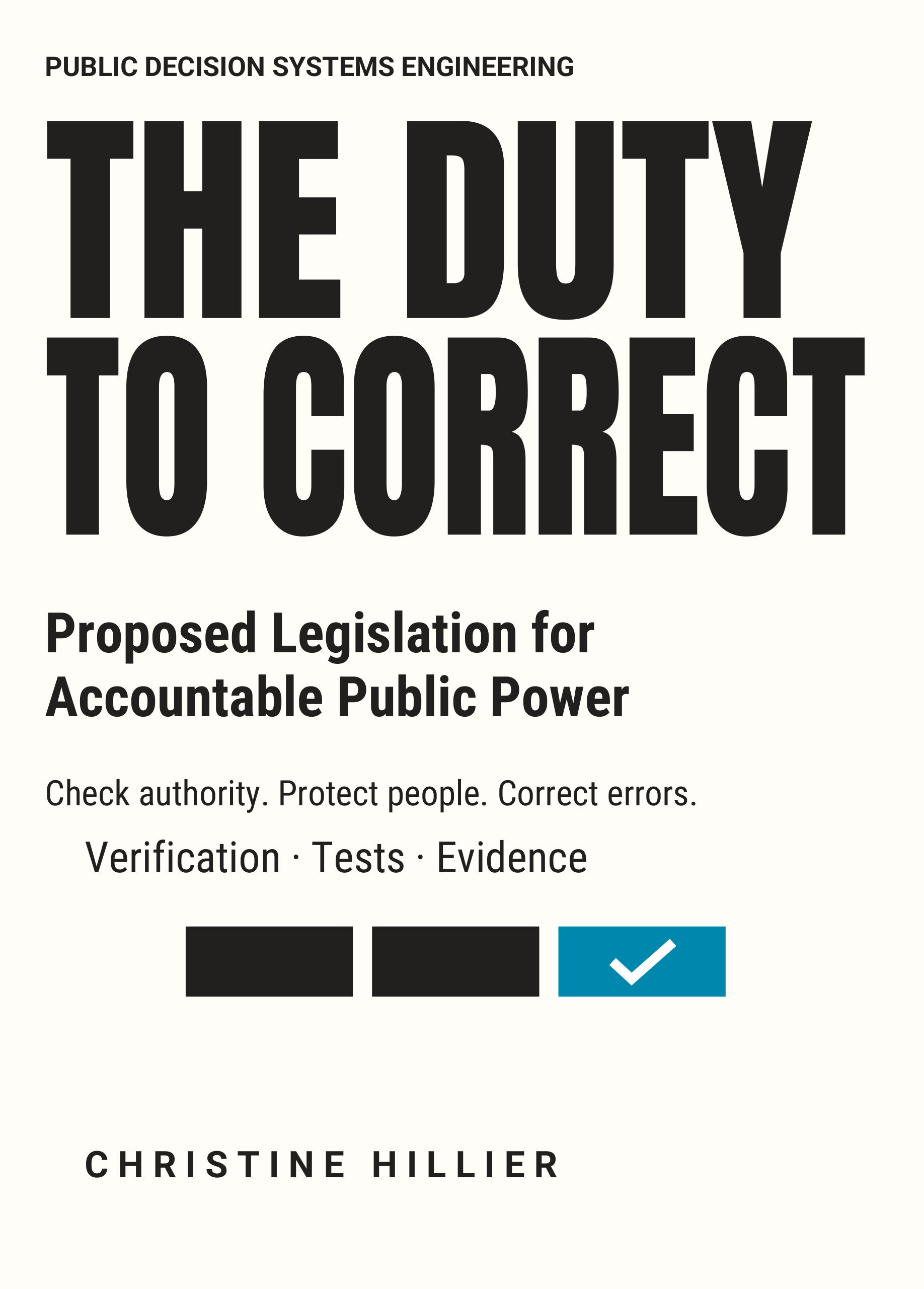
The Duty to Correct · Christine Hillier
About the book
A record can affect your freedom, your family, or your access to care. The Duty to Correct connects public protections to requirements that can be implemented, inspected, and tested. You should not have to wait for the decision maker to admit an error before you can challenge it.
Separately printable
Proposed duties, review, enforcement, and implementation provisions for the federal level.
Read the federal proposal (PDF) →A model state proposal for consideration and adaptation within the relevant legal system.
Read the model state proposal (PDF) →Author proposals from the expanded teaching edition. They are not enacted laws or government-issued standards.
Verification · Tests · Evidence
The companion includes a finite authorization model, correction delivery with an offline recipient, stale-record replay, and other synthetic examples.
Some activities are worked references or human exercises supplied for the reader to perform. Automated checks evaluate the stated models; they do not establish legal validity, field effectiveness, or insurability.
Download the synthetic lab bundle (ZIP) →Read the recorded results (TXT) →Extract the bundle. With Python 3.10 or newer, run:
python3 run_labs.py --output resultsRead each model's assumptions and limits alongside its output. Use the results to identify what still needs independent review.
Connected work