Verification
Proof precedes irreversible authority.
FOUNDER · SYSTEMS ARCHITECT · ELECTRICAL ENGINEER
Engineering operationalized rights to remedy infrastructure.
Building systems that make evidence observable, authority verifiable, accountability durable, and remedy executable.
THE WORK
Kapukai Governance Lab engineers infrastructure for high-consequence decisions where evidence, identity, custody, authority, institutional memory, and remedy must remain structurally connected and independently auditable.
The work converts complex human and institutional failures into observable architecture: verified chronology, evidence systems, authority mapping, controlled decision pathways, accountability mechanisms, and operational routes to remedy.
Proof precedes irreversible authority.
Evidence, identity, authority, memory, accountability, and remedy remain interlocked.
The greater the potential harm, the higher the required verification threshold.
FOUNDER BIOGRAPHY
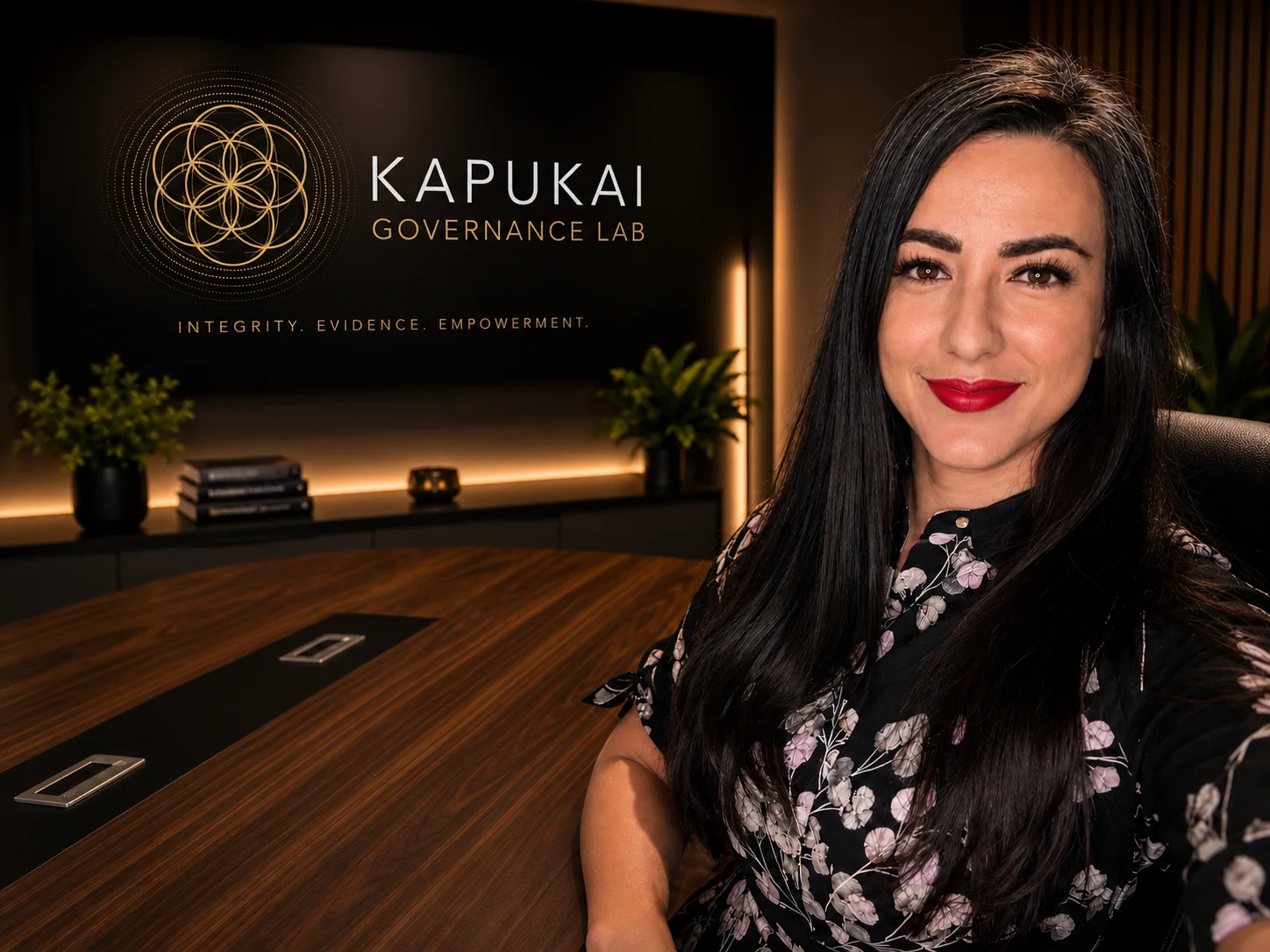
Christine Kanoelehua Hillier is the Founder and Systems Architect of Kapukai Governance Lab.
Trained in electrical engineering and software architecture, she applies systems engineering, evidence architecture, control principles, and governance design to institutions whose decisions affect liberty, family integrity, bodily autonomy, identity, safety, and survival.
Her work is grounded in a direct operating constraint: systems exercising consequential authority must be able to show what they know, how they know it, who authorized action, what information was preserved, and what remedy exists when the system is wrong.
Kapukai therefore treats rights to remedy not merely as legal language, but as an infrastructure requirement that must be designed, tested, observed, and made executable.
VERIFICATION PRECEDES IRREVERSIBLE AUTHORITY.
Read the Standard →